Internet will be the most important prime mover of change for our print and electronic media as we cross the threshold of the next century. It will bring about the greatest revolution in mass communications since the invention of moveable type for printing. Unlike the previous one, which took centuries in reaching all parts of the world, the present revolution has already made its impact globally within a few years after its introduction.
The use of previous technologies was primarily a matter of choice for the publisher or the broadcaster. The newspaper reader was not even aware of hot metal or photo-composing, and letterpress or offset printing. Similarly, a radio or television broadcaster could make his own choice of technology. The adoption of Internet, however, has become a compulsion for both the publisher and the broadcaster. This technology truly has a mass appeal and the readers and viewers expect its use as soon as they become aware of its advantages. Therefore, the Internet will take only a short period in transforming the mass communications even in the developing countries.
Inertia of conservatism. Inertia, however, will be the biggest hurdle in the widespread use of Internet. Our editors, who are supposed to be the harbingers of change, are surprisingly themselves extremely conservative in adopting new technologies relating to their own job. Teletype, for example, was widely used by the Euro-American dailies for decades until personal computers replaced it. But our English newspapers never asked the APP and PPI to provide it despite its great advantage of automatic typesetting of news agency feeds. They could save much time and labor every day in composing and proofreading stories that did not require editing, such as stock exchange quotations, sports results, texts of official announcements and speeches, even many foreign and national stories.
Many other things could have been done for improvement. Many of the technologies that provide a platform today for the Internet were available years ago. Over 13 years ago, I prepared a report for the modernization of the Associated Press of Pakistan. The technologies and processes that were recommended in the report for reporting, editing, transmission, etc. of news were not much different from what we shall be seeing in the near future. Nor was the cost prohibitive. For a very small amount, the agency could have not only modernized itself completely (including getting rid of teleprinters), but also become able to provide its news service in English as well as Urdu without any extra cost! It would have also reduced drastically the composing costs of both the English and Urdu dailies. Just imagine how much improved our media would have been by now if the proposals had been implemented.
The conservatism in the media persists and is already slowing the adoption of Internet. The use of email, for example, is still rare in all media. Very few give as much importance to email as to phone and fax, even though it is more reliable, faster and far more economical than either of the two. There is also very little coverage of the information technology both in the print and electronic media because the editors themselves don’t know much about it!
The Internet, however, has gained such a momentum on its own that the newspaper, radio, television and other media will soon be overwhelmed by it. The question is not of if but of when Internet will be fully embraced.
The way to paradigm changes. The complete adoption of Internet will have a profound impact on our media. It will bring about paradigm changes not only in the processes, like reporting and editing, but also transform the very nature of the media.
Reporting will be an entirely new kind of process. The pen and notebook may remain in a reporter’s pocket for the time being, but he will be pounding on the keyboard of a very small computer for writing a story. The moment a story is done, it will be on its way to the destination. (As we shall see a little later, it will apply to stories in Urdu also.)
The reporter will no longer be writing just stories. He will be using a digital camera for taking pictures that will accompany his stories. (The extra payment for pictures – which will be in color – will easily justify the purchase of the camera, even if he has to buy it on his own.) There will be no developing and printing of film, nor delays in the delivery of prints by a courier. In fact, the pictures will be ready before even the story is written! Even if a reporter is not a good photographer, it will not matter because his editors will easily remove the defects in his pictures.
A story and the accompanying pictures may reach the newspaper as email attachments wherever the reporter may happen to be. He will, in fact, no longer be bound to his office or tethered to the wire of an ordinary telephone. Even the remote villages will soon have wireless (but fixed) phones, which are already being installed by private companies in tens of thousands in collaboration with Pakistan Telecommunication Co. Ltd. Then there will be the cellular mobile phone, which will provide Internet connection, and will be cheaper and much more ubiquitous than at present.
If the editor is not satisfied or wants more details, he will not hesitate in calling the reporter wherever he may be, even in the remotest areas. A trunk call will no longer be an expensive affair. In December 2002, the monopoly of Pakistan Telecommunication Co. Ltd will be over. With the dawn of the New Year, the Internet service providers will introduce Internet telephony legally. A phone call will then cost only Rs 30 t0 40 per hour (at present connection charges), irrespective of the reporter being in Nushki, Nawabshah, Nowshera or New York!
An alternative to a phone call will be what is called “chatting” in the Internet jargon. It is conversation in writing on an Internet connection, with words and sentences being typed alternately by the participants, just as they speak on a phone. When coordinated reporting on a major story is required, the reporters and editors may chat with one another simultaneously.
Editors will have a much more harried life. Internet will be bringing to their computer monitors stories and pictures every minute in an unceasing stream. As if it was not enough, it will also be impossible to finish a story and forget about it because updates will be constantly pouring in. The radio and television will be coping with the problem by broadcasting more and more bulletins. (A news channel of the Pakistan Television is on its way. How far behind will be Radio Pakistan?)
The print editors, by the nature of their medium, will be torn in two opposite directions. On one hand, they will have to prepare complete and comprehensive stories for the morning edition. On the other hand, many dailies will have web sites, where latest news will be placed literally every minute, with revisions and updating round the clock. (There may be pressures to bring out several editions of dailies during the day but the production and distribution costs will be prohibitive for most of the publishers. There may also be little demand from the readers, who have money and time for just one paper a day.)
Not just the news. The stories in the next morning’s edition will also require a completely different treatment. The Internet (along with the frequent news bulletins of radio and television) would have already given most of the W’s of a story. The only one left will be Why (and to some extent also How). While giving the basic facts, a story will have to concentrate on analysis and background if a reader is expected to read it the next morning.
The newsmagazines have a much harder time. Some years ago, the Time magazine decided to study its own future. The cable news channels, and later the Internet, took the bottom out of the newsmagazine’s primary function of providing a summary of the week’s news. It concluded that the only way it could survive in the age of instant news was by providing depth, background and analysis of events and trends. So, you will today find Time (and, inevitably, Newsweek) to be very different from what it used to be. And the cost of inertia? A leading Indian newsmagazine, Sunday, lost half of its circulation because it failed to change.
News stories for the media are no longer scarce. Internet has opened the floodgates of news about all parts of the world and on all imaginable subjects. Thousands of newspapers and magazines already have their web sites and more are joining them every day. Then many new specialized agencies cover various fields. Gone are the days when a few international news agencies controlled the flow of news because only they had the worldwide network for the distribution of news. Now many alternatives are available, including original sources of various countries. If, for example, an editor wants to give more coverage to the Muslim World, he will have no difficulty in getting all the stories (and pictures) that he can publish.
The Internet will bring some relief to the space problems of newspapers. The editors always struggle to put in all the stories for fear of missing any important one but the number of pages fixed by the publishers frustrate their efforts. With Internet, the editors will be able to place full texts, lengthy details and less important stories on their web sites when they can’t have enough space in the paper edition.
Equal opportunity for Urdu. The Urdu newspapers, which have always lagged behind their English contemporaries, will not find it difficult this time to catch up technologically. In the early days, a computer could use only 128 characters (in the 8-bit ASCII code), which were obviously not enough. A subsequent code, EBCDIC, doubled the number of characters (letters, numbers, punctuation, etc.) but that again did not go far enough.
Finally, after the technical limitations were overcome, the computer industry adopted the UNICODE, a 16-bit character-encoding standard, developed by the Unicode Consortium between 1988 and 1991. By using two bytes to represent every character, UNICODE enables almost all of the written languages of the world to be represented using a single character set. Approximately 39,000 of the 65,536 possible UNICODE character codes have been assigned to date, 21,000 of them being used for Chinese ideographs. The remaining combinations are open for expansion.
It is understood that Microsoft will provide full support for Urdu in Windows 2000, making it possible to use the computer in our own language exactly the same way it is done in English. (By the way, it will also be possible to use computers for all of our regional languages with the same ease if character codes for them are assigned!)
Despite the technical limitations, however, we could have still expedited the use of Urdu computing if we had simply followed and adapted whatever research and development was being done for computing in Arabic. (And it was quite a lot, because of the petro-dollars flowing around in the 1970s and 1980s.) Unfortunately, we insisted on the use of the Nasta’lique form of the script, which is not entirely character-based, and hence could not be used easily in computers. Naskh is used by all other languages of the world, which are written in the Arabic script, including our own regional languages. If Urdu had been doing the same, we could have saved many years in making full use of computing and also not wasted millions of man-hours on developing software (and that too inadequate) for Nasta’lique. (The handicap still persists because even UNICODE will not make it easy to use Nasta’lique.) By discarding the use of Nasta’lique and adopting Naskh, we would also have improved tremendously the typesetting technology for Urdu print media but that is another story.
Basic problems for newspapers... The widespread use of Internet will pose some fundamental problems for the newspapers. For example, why should the reader buy a newspaper when he will be able to get the news on the Internet instantly and that too according to his preferences and free of charge? It may give sleepless night to publishers but there are several reasons why they should not despair. There are several reasons why a reader will still need a newspaper:
a) The news may be free but it will still cost money in the form of Internet connection charges. A reader may download stories for later reading and save connection time but he will not get “the whole thing.”
b) Advertisements in the paper also have news value, say, when new products and services are announced, vacancies are publicized, free offers are made.
c) Only a newspaper provides the ultimate convenience of (i)carrying it around, (ii) splitting it among several readers, (iii) reading it in fits and starts (because of interruptions throughout the day), (iv) reading it while travelling in a bus or train, (v) tearing out stories, pictures and ads for reference, (vi) spreading it on the ground for sitting in a park or having a picnic, and (vii) taking it to the bathroom in the morning.
d) The newspaper can be recycled for packing, wrapping, etc. or sold as raddi (waste paper).
The newspaper publishers also need not fear that Internet will take over the news completely. The free news is great for the reader but a burden for the provider. Some attempts were made to charge a subscription for the Internet editions of newspapers. An outstanding example was that of The New York Times, which thought it could pull it off because of its prestige and influence. But it had to climb down soon and join the others, such as The Washington Post, who were making their complete contents available on their web sites without charge.
The placing of a newspaper on the Internet does cost money. The advertisement revenue could be the only alternative to subscription charges to meet the expenses but Internet has not proved to be an effective medium for it. The advertisers somehow believe that they get better value for their money from the newspapers than the Internet. Therefore, independent news providers cannot find any way to meet their expenses while the newspapers can continue to provide the Internet edition, though only as a prestigious subsidiary of their normal operations.
… and electronic media. More and more radio and television stations around the world are making their programs available on the Internet. You can listen to music or news on a radio or watch a television program even if it is being broadcast on the other side of the world. Since audio and video require much larger capacity (technically called “bandwidth”), our own Internet users will have to wait till digital subscriber lines are provided to them by the phone company at a very low cost. Pakistanis in many countries, however, are not handicapped by small bandwidth and can even now enjoy programs of Radio Pakistan and Pakistan Television.
Like the newspaper publishers, the radio and television broadcasters will also have to bear the costs of placing their contents on the Internet without any hope of return. For them too, it will be a prestigious subsidy.
The Internet, however, provides simultaneous worldwide coverage to the radio and television, far beyond the present normal coverage area. If the audience abroad grows large enough, the broadcasters may think about abandoning their satellite transponders, which cost millions of dollars per year but cover only one-third of the globe at the most. In addition, the users need a dish antenna or a cable television connection. The satellite service providers will have a very hard time selling the vacated transponders to others. Then the Internet service providers may come to their rescue and use their services for transmitting large data files from web sites. The files may well be television programs! The television (and radio) may thus still use the satellite but in a roundabout way and at a very low cost.
The age of self-publishing. The Internet has given a new meaning and possibilities to publishing. It will reduce the dominance of the major publishers and allow “a thousand flowers to bloom.” In the conventional way, a new newspaper normally requires tens of millions of rupees. (Hsssh! Bring your ear close to me. If you know somebody who wants to bring out a daily newspaper, tell him that I know how to do it with merely lakhs of rupees!) On the Internet a new newspaper, magazine or even a book can be published at a very, very small cost and for the whole world to read.
The obstacles on the way. Finally, how long will it take the Internet to have its full impact on our print and electronic media? Revolutions do not take place overnight because the human societies take their own time to change. The Internet, however, may make its way rather easily. The prices of personal computers have been falling continuously. The telephone network will improve and expand further after the monopoly of the PTC ends in 2002. Then will remain the cost of Internet, which can be brought down substantially if (a) the rates charged by PTC for international connectivity are based on actual costs, and (b) the license fee for the Internet service providers is abolished. And if PTC provides nodes for Internet at every district headquarters, the Internet can reach economically even the remote areas.
After the Internet becomes affordable and easily available in every part of the country, the media even in the least developed areas will be revolutionized. It will be a great day for mass communications.
The paper was read at a two-day seminar on “The Challenges of the New Millenium and the Media,” held at Murree, on August 2-3, 1999, organized by the Department of Mass Communications of the University of the Panjab. The teachers of Mass Communications of all universities of the country participated.
The writer is a specialist on information technology, Internet, computing, telecommunications, broadcasting and newspaper technology.
Wednesday, April 13, 2005


TALIBAN: What did the Taliban do wrong?
Here are some of the things the Taliban in Afghanistan should or should not have done:
a) Be tolerant to ordinary people
The ordinary Afghan people could not adjust easily to the imposition of harsh religious measures, even if these were justified and well-intentioned. Following the Sunnah of the Holy Prophet, the Taliban should have allowed more time, used more persuasion and applied less pressure to bring the Shariat into the daily lives of the people. The ordinary people cannot reach the highest moral standards immediately.
b) Economy comes first
The Taliban should have given more attention and resources to improving the economy of the devastated country and to creating job opportunities. It was extremely difficult for most people in the war-ravaged country even to survive. The religious agenda could become more acceptable after the most people had at least two square meals a day.
c) Some education for girls was better than no education
The Taliban could have set up separate schools and other educational institutions for girls. They could also change the courses and syllabi for them. But they should not have closed the existing schools and institutions while preparing to achieve their objectives.
d) Begging is not better than jobs for women
There could be segregation for women but they should have been allowed to continue with their existing jobs in education, health services, etc. That would not have forced them to beg on the streets. It would have also avoided the complaints of human rights organizations in the West that led to the stoppage of humanitarian aid in many cases. In due course, opportunities could have been created for women to have jobs that did not involve mixing with men.
e) You cannot be aloof from the world
You may not care for the world but you cannot afford to ignore it. There was no harm in listening to what the others, particularly in the West, said and suggested. By removing some of their complaints, the Taliban could have gained more recognition, more aid and better understanding. They also could get more international sympathy and support against what the US was raring to do. Every poor country needs these things to survive and make life somewhat easier for its people.
f) Being Muslims would have been better than being Pashtuns
The Taliban should have behaved like true Muslims and made a compromise with the Northern Alliance, instead of trying to crush and overpower them with force because they were not Pashtuns. By treating the people in the North as brothers and giving some concessions to their leaders, they could bring the entire country under a single government. It would have not only gained more international recognition (however grudging) but also denied the Americans a foothold on Afghanistan territory and a readymade Northern Alliance force to use against them. (The US so has been unable to attack Iraq mainly because it cannot put its feet anywhere inside the country.)
g) Usama should not have been retained at all costs
Usama might have been a benefactor to Afghanistan before and after the Taliban came into power. There also may be a strong Afghan tradition of not throwing out a guest. Still, without being rude to him, Usama could have been asked to change his residence for the time being, especially after the ulema had recommended it. After all, Usama did leave Afghanistan after the collapse of the Taliban. He could have done so earlier and saved such havoc to the Afghan people and the Taliban themselves.
h) Peace is always better than war
Unlike the common belief, history doesn’t repeat itself. If the Taliban knew the history of their wars with the British and the Russians, so did the Americans. If the Taliban believed that a guerilla war would go their way, so did the Americans. So, the Taliban should not have deluded themselves to believe that the Americans would repeat the blunders of previous imperialist powers and give them a war of their own choice. Any peace arrangement, therefore, was certainly preferable to an all-out war.
i) Never be arrogant
When the official delegation from Pakistan went to meet Mulla Umar to persuade him to agree to a compromise in view of the very aggressive mood of the Americans, he was reported to have refused to listen, saying, “Don’t lecture to us. You never won any war and we never lost one.” The pride doth have a fall. Even the Holy Prophet chose peace when a war would not have been in the national interest.
The history of the region would have been vastly different if Mulla Umar had listened to Pakistan and found a way out. We can always learn from history. He too must have realized it by now – wherever he happens to be at present.
a) Be tolerant to ordinary people
The ordinary Afghan people could not adjust easily to the imposition of harsh religious measures, even if these were justified and well-intentioned. Following the Sunnah of the Holy Prophet, the Taliban should have allowed more time, used more persuasion and applied less pressure to bring the Shariat into the daily lives of the people. The ordinary people cannot reach the highest moral standards immediately.
b) Economy comes first
The Taliban should have given more attention and resources to improving the economy of the devastated country and to creating job opportunities. It was extremely difficult for most people in the war-ravaged country even to survive. The religious agenda could become more acceptable after the most people had at least two square meals a day.
c) Some education for girls was better than no education
The Taliban could have set up separate schools and other educational institutions for girls. They could also change the courses and syllabi for them. But they should not have closed the existing schools and institutions while preparing to achieve their objectives.
d) Begging is not better than jobs for women
There could be segregation for women but they should have been allowed to continue with their existing jobs in education, health services, etc. That would not have forced them to beg on the streets. It would have also avoided the complaints of human rights organizations in the West that led to the stoppage of humanitarian aid in many cases. In due course, opportunities could have been created for women to have jobs that did not involve mixing with men.
e) You cannot be aloof from the world
You may not care for the world but you cannot afford to ignore it. There was no harm in listening to what the others, particularly in the West, said and suggested. By removing some of their complaints, the Taliban could have gained more recognition, more aid and better understanding. They also could get more international sympathy and support against what the US was raring to do. Every poor country needs these things to survive and make life somewhat easier for its people.
f) Being Muslims would have been better than being Pashtuns
The Taliban should have behaved like true Muslims and made a compromise with the Northern Alliance, instead of trying to crush and overpower them with force because they were not Pashtuns. By treating the people in the North as brothers and giving some concessions to their leaders, they could bring the entire country under a single government. It would have not only gained more international recognition (however grudging) but also denied the Americans a foothold on Afghanistan territory and a readymade Northern Alliance force to use against them. (The US so has been unable to attack Iraq mainly because it cannot put its feet anywhere inside the country.)
g) Usama should not have been retained at all costs
Usama might have been a benefactor to Afghanistan before and after the Taliban came into power. There also may be a strong Afghan tradition of not throwing out a guest. Still, without being rude to him, Usama could have been asked to change his residence for the time being, especially after the ulema had recommended it. After all, Usama did leave Afghanistan after the collapse of the Taliban. He could have done so earlier and saved such havoc to the Afghan people and the Taliban themselves.
h) Peace is always better than war
Unlike the common belief, history doesn’t repeat itself. If the Taliban knew the history of their wars with the British and the Russians, so did the Americans. If the Taliban believed that a guerilla war would go their way, so did the Americans. So, the Taliban should not have deluded themselves to believe that the Americans would repeat the blunders of previous imperialist powers and give them a war of their own choice. Any peace arrangement, therefore, was certainly preferable to an all-out war.
i) Never be arrogant
When the official delegation from Pakistan went to meet Mulla Umar to persuade him to agree to a compromise in view of the very aggressive mood of the Americans, he was reported to have refused to listen, saying, “Don’t lecture to us. You never won any war and we never lost one.” The pride doth have a fall. Even the Holy Prophet chose peace when a war would not have been in the national interest.
The history of the region would have been vastly different if Mulla Umar had listened to Pakistan and found a way out. We can always learn from history. He too must have realized it by now – wherever he happens to be at present.
SRI LANKA: How to restore peace in Sri Lanka
How can we get rid of a large sprawling tree, with deep roots in the ground? There are two methods. One is to have strong ropes and many men to use them. The ropes are tied to the big branches and the men pull them down one by one. Later, more time and effort are needed to cut the branches into small pieces and clear the ground. The main trunk may also be attacked. The stump will, however, remain there in any case and after some time the tree may start reproducing itself again. It will be a temporary success at best, despite the use of a lot of time, energy and resources. We may call it "the frontal attack."
The other method is to dig around the tree, isolate its roots and deny them sustenance of any kind. The roots will soon dry and the tree will start withering away. Then it may be easily pulled out, roots and all. Or the nature will take care of it. This method may be called "striking at the roots."
The frontal attack. The problem in the North of Sri Lanka is just like a sprawling tree. To get rid of it, the frontal attack was made right in the beginning. There were infantry forays into the troubled areas, accompanied by tanks and artillery and air attacks. There were offensive attacks as well as combing and mopping up operations. There was sea blockade from all sides. There was show of force as well as defensive action. It has been going on for 15 long years, at a colossal cost of human lives and resources. To outsiders, the whole country appeared to be under siege. The bomb blasts right in the heart of Colombo were heard all over the world. Directly or indirectly, every Lankan has been paying a heavy price. And he yearns for peace. Yet, peace has been as elusive as ever.
If it were an insurgency like the one that took place in the South of the island years ago, it would have been quelled long, long ago. But the roots of the conflict in the North lie deeper and call for a methodical strike at the roots. The roots, however, are not in the bunkers of the rebel hideouts.
The rebels, all over the world, are always prisoners of their own cause. Their motivation and commitment depends entirely on a single, clear objective, with total disregard for any possible alternative. The rebels in the North want a separate state. (They are rebels in every sense and cannot be called "Tigers," in view of the havoc they have caused to their own people.) On the battlefront, they have been fighting for only an outright victory. At the conference table, they expect only an abject surrender by the Government. For them, there is no compromise, no middle ground. Therefore, any peace talks or negotiations with them, however sincere, or any confidence building gestures towards them, however well meaning, will be as fruitless as ever. For the rebels to accept any solution offering less than a separate state will mean ignominy forever. Therefore, they will never be willing to compromise. Talking with them will only a waste of time. There is no use banging one’s head against stones, as we say in Urdu.
Foreign intervention. The rebels would have been much more obstinate if they had any open foreign support for their cause. The covert support never went beyond the supply of arms and ammunition, equipment and other essentials. When the foreign intervention did come, it was luckily against the rebels themselves. (If it were the other way, "Tamil Eelam" would have been created long ago.)
The Indian intervention dashed forever whatever hopes the rebels had. They could no longer expect any outside assistance in achieving their objective. That was an opportune moment for the Lankan Government to end the war through peaceful means. (It is not necessarily a contradiction in terms because wars cannot be won only with weapons of destruction.) The opportunity was lost due to the rigidity of the then rulers. They continued to have an obsession of achieving military victory, irrespective of the disastrous consequences and without much likelihood of success.
If even now an outright military victory is not likely in the very near future, the alternative should be to strike at the roots of the rebels. Those roots lie in the ordinary people of the North. They were promised a land of milk and honey by the rebels and were persuaded to support them for the "great cause." They might have been hopeful in the beginning about the success of the rebels. Now they must be totally disillusioned and yearning for peace. War is never the choice of the common man. For him peace comes first. Now, therefore, is the time to bring him over to the Government side so that he denies cover, information, food or any other sustenance to the rebels. Once isolated, the rebels, like roots of a tree, will not be able to survive long.
Unilateral and immediate cease-fire. To win over the ordinary people in the North, the first bold step by the Government should be to cease fire with immediate effect. It should be unilateral and without any formal agreements with the rebels. (The agreements have been worthless in the past, in any case). There should not be even a formal announcement so that military action may still be possible whenever unavoidable. The Government may simply ask the armed forces stay wherever they are at present and stop military action unless deliberately provoked by the rebels. (For the inquisitive journalists seeking confirmation of a cease-fire, the standard reply in such matters should come handy: "No comments.")
The news of the cease-fire will spread in the troubled areas by the word of mouth. It will be a message to the ordinary people that they no longer need to be afraid of the presence of the army in their areas. It will also be a message to the rebels that there will be no action against them as long as they do not provoke the army. If there is no rebel activity in an area, there will be no military action either. (It may encourage desertions among the rebel ranks.)
Picking up the pieces. Once the ordinary people are convinced that they will no longer be affected by any military action, their first action will be to start picking up the pieces of their life. Sick and tired of the war, they will naturally be keen to resume a normal living. They are also likely to resist any pressures from the rebels for support because the alternative of siding with the Government will be far more preferable.
To bring about a change of heart among the common people will be an uphill task. It will also require maximum help from the Government. Still, many things can be done to make life easier for them. The normal supply of food and other essentials may be allowed to the affected areas. To rebuild houses and shops, the cement, steel, wood and other construction material may be made available. (With the armed forces remaining in place wherever they are at present, it should not be possible for any supplies to be diverted to the rebels.)
The next step should be to repair and restore the infrastructure. Electricity, postal and telecommunication services should be restored, the roads should be repaired, schools, hospitals and banks should be reopened. The Government offices may resume normal working. The object will be to do whatever is needed, and in minimum possible time, to meet the needs of the war weary people.
It is imperative that people should be able to start earning a living, just as they did before the rebellion started. The farmers should be able to plough their fields and sow crops, the shops should reopen and the businesses and factories should resume operations. They should be given funds for reconstruction, as grants as far as possible. The loans should be on very easy terms, preferably without interest.
The Government employees, including teachers, doctors and hospital staff, should be allowed to resume their duties wherever they had been serving earlier. The transport, particularly on the roads, should be running normally, even though movement from the North to the rest of the country will remain restricted for security reasons. The local people in the North should be given preference for all jobs so that more and more of them have a stake in the new situation.
It is not implied at all that suddenly everything can be made normal. The areas where the rebels are active will continue to be disturbed. But there is far larger territory where people can resume normal life without affecting the military operations in any way. These areas need the initiative and the concentration of peace efforts.
The object will be to assure the ordinary people in every possible way that they are no longer the target and can live just like other citizens elsewhere in the country. There may still be some subversives, who will try to help the rebels. They can be isolated and captured if the others around them are convinced that any help to the rebels will jeopardize the return to peace.
Alternatives for the rebels. With the ordinary people finally returning to normal life, what will happen to the rebels? The rebel leadership, however it may try, is unlikely to convince its cadres of good days to come soon. It cannot give rise to any realistic hope of success, even in the distant future. And, all said and done, the toughest fighters are also human beings and do yearn for a peaceful living at the end of the day. Like the ordinary people, the frustrated rebels should also be given an opportunity to return to a normal life.
The rebels may be offered three alternatives. Those who want to leave the country may be allowed to do so, provided they get sponsors abroad who meet all their expenses and arrange immigration visas for them. Those who want to remain in the country and live a normal life may be asked to provide at least five responsible persons of their own community to stand sureties for their behavior. The remaining rebels, if they surrender voluntarily, may be offered detention in camps where, under tight security, they will do various jobs or may learn new skills (agricultural, manufacturing, processing, technical, services, etc.). Their detention period may be five to ten years, enough to bring about a change in their thinking and plans. Those who committed crimes or become fugitives will be dealt with under the law.
Back to square one. Once the normalization process starts, it will be quite natural for the people in the North to think about their future. That will be the time to convince them that they will be better off with the rest of the nation. The rebels might have succeeded in persuading them in the initial stages that they will soon get the Promised Land. Now, after a decade and a half of misery and sorrow, they know they are nowhere near that, nor are likely ever to be. Therefore, it should be easy to offer peace and prosperity to these disillusioned masses.
That will be actually going back to the square one. During 1981-82, while I was living in Sri Lanka, the Tamil problem did not appear to me to be insurmountable. The leaders of the Tamil United Liberation Front (TULF) essentially demanded (a) elections to the provincial councils under the new constitution and (b) autonomy for the North to be able to solve local problems on its own. It was not something that could not be settled through negotiations. During discussions with friends, I would often quote the example of my own country. The basic dispute between East and West Pakistan was on autonomy and share in power. If the rulers in the West had a proper understanding of the feelings in the East and were magnanimous enough to give and take, the problem could have been solved. However, their stubbornness and megalomania took them to the use of brute force. The covert and overt Indian intervention did the rest. The result was a disaster in 1971. Yet, the rulers in Sri Lanka were repeating the very same behavior. Why didn't they learn a lesson from something that had happened right in their own neighborhood just a few years ago? They did not want to. So, they were condemned to repeat the very same blunder.
Is it now possible to go back to the original constitutional provisions and hold elections for the councils in all provinces (not just in the North and the Northeast)? It is, though it will not be easy. The priority should be not to allow the rebels to come into power in any way. The election rules can provide that no rebels, their frontmen or sympathizers, will be allowed to become candidates for any post. Keeping the rebels away in just two elections will give enough time to the new faces to become old hats. Politics, like nature, abhors vacuum. By the third election, the rebels will have a very hard time even being recognized at the election rallies. In 1985, Benazir Bhutto, living in London, decided to boycott the general elections in her country. Her imperious presumption, as quoted by The Daily Telegraph, of London, was that, without her being in the field, only 10-15% voters would cast their votes. The polling was about 50% and many totally new faces entered the National and Provincial Assemblies. Benazir never again boycotted any elections!
While the new members of the Provincial Councils in the North and the Northeast find their way, their hands should be strengthened with more powers to deal with local problems. They should also be given extra funds (which will still be peanuts, compared to what was being spent on the war.) They will thus be enabled to convince their people that they offer a much better alternative to what the rebels had been promising.
Filling the stomachs. How to heal the wounds? At the human level, it will take a long time, at least a generation or so. However, the hardships of daily life can be reduced immediately. The people in the affected areas will need jobs to be able to stand on their own feet. (Every thing appears hollow and false if ones stomach is empty, as we say in Punjabi.) Economic wellbeing always helps in diluting, and finally forgiving, the bitterness of the past. That will require investment and business activity. With so many burdens and liabilities, the Government will not be able to provide large enough funds. It need not, except for repairing its own infrastructure.
What the Government should do is to set up special industrial zones in Jaffna, Trincolmalee, Batticaloa and some places in the interior. These zones should be primarily for labor-intensive, export-oriented industries. If the basic facilities are provided, it will not be difficult to attract investment, especially for export. The money for projects in these zones will come mostly from the Tamil expatriates in Australia, Europe and North America. The foreign governments and international organizations will also help.
The links between the North and the rest of the country, especially Colombo, should be made stronger than before the war. Easier and comfortable travel will be very helpful. During my stay in Colombo in 1981-82, I would often see a shining luxury bus parked outside a cinema in Wellawatte, on the Galle Road. It would leave Colombo in the evening and reach Jaffna in the morning, without any problem during the night journey. The following night it would travel back. It was a great symbol, of modernity, of national unity, of tranquility in the land. It will be a great day when that bus will start running again on its old route. For one, I would love to be a passenger on that bus. (Somehow, I could not make it the last time.)
Army of peacemakers. Meanwhile, what will happen to the armed forces personnel after the military action in the North is phased out? They will have to be demobilized as peace is restored. However, it has to be recognized that they have been fighting with courage and tenacity and have made tremendous sacrifices for the unity of their country. They certainly deserve full recognition and suitable reward for their services. Since they have excellent relevant experience, they can be placed at the disposal of the UN for peace-keeping duties in various parts of the world. (Coming from a small, neutral country, the offer will not get any opposition.) They will enjoy a permanent stay abroad and salaries (in US dollars) that will be much more than they can get for any job at home. They will deserve it, after peace is restored in their own country.
This paper was written in May 1998 by Muhammad Abd al-Hameed, a Pakistani researcher and writer, with special interest in Sri Lanka. He lived in Colombo in early 1980s and visited the country twice during the 1990s.
The other method is to dig around the tree, isolate its roots and deny them sustenance of any kind. The roots will soon dry and the tree will start withering away. Then it may be easily pulled out, roots and all. Or the nature will take care of it. This method may be called "striking at the roots."
The frontal attack. The problem in the North of Sri Lanka is just like a sprawling tree. To get rid of it, the frontal attack was made right in the beginning. There were infantry forays into the troubled areas, accompanied by tanks and artillery and air attacks. There were offensive attacks as well as combing and mopping up operations. There was sea blockade from all sides. There was show of force as well as defensive action. It has been going on for 15 long years, at a colossal cost of human lives and resources. To outsiders, the whole country appeared to be under siege. The bomb blasts right in the heart of Colombo were heard all over the world. Directly or indirectly, every Lankan has been paying a heavy price. And he yearns for peace. Yet, peace has been as elusive as ever.
If it were an insurgency like the one that took place in the South of the island years ago, it would have been quelled long, long ago. But the roots of the conflict in the North lie deeper and call for a methodical strike at the roots. The roots, however, are not in the bunkers of the rebel hideouts.
The rebels, all over the world, are always prisoners of their own cause. Their motivation and commitment depends entirely on a single, clear objective, with total disregard for any possible alternative. The rebels in the North want a separate state. (They are rebels in every sense and cannot be called "Tigers," in view of the havoc they have caused to their own people.) On the battlefront, they have been fighting for only an outright victory. At the conference table, they expect only an abject surrender by the Government. For them, there is no compromise, no middle ground. Therefore, any peace talks or negotiations with them, however sincere, or any confidence building gestures towards them, however well meaning, will be as fruitless as ever. For the rebels to accept any solution offering less than a separate state will mean ignominy forever. Therefore, they will never be willing to compromise. Talking with them will only a waste of time. There is no use banging one’s head against stones, as we say in Urdu.
Foreign intervention. The rebels would have been much more obstinate if they had any open foreign support for their cause. The covert support never went beyond the supply of arms and ammunition, equipment and other essentials. When the foreign intervention did come, it was luckily against the rebels themselves. (If it were the other way, "Tamil Eelam" would have been created long ago.)
The Indian intervention dashed forever whatever hopes the rebels had. They could no longer expect any outside assistance in achieving their objective. That was an opportune moment for the Lankan Government to end the war through peaceful means. (It is not necessarily a contradiction in terms because wars cannot be won only with weapons of destruction.) The opportunity was lost due to the rigidity of the then rulers. They continued to have an obsession of achieving military victory, irrespective of the disastrous consequences and without much likelihood of success.
If even now an outright military victory is not likely in the very near future, the alternative should be to strike at the roots of the rebels. Those roots lie in the ordinary people of the North. They were promised a land of milk and honey by the rebels and were persuaded to support them for the "great cause." They might have been hopeful in the beginning about the success of the rebels. Now they must be totally disillusioned and yearning for peace. War is never the choice of the common man. For him peace comes first. Now, therefore, is the time to bring him over to the Government side so that he denies cover, information, food or any other sustenance to the rebels. Once isolated, the rebels, like roots of a tree, will not be able to survive long.
Unilateral and immediate cease-fire. To win over the ordinary people in the North, the first bold step by the Government should be to cease fire with immediate effect. It should be unilateral and without any formal agreements with the rebels. (The agreements have been worthless in the past, in any case). There should not be even a formal announcement so that military action may still be possible whenever unavoidable. The Government may simply ask the armed forces stay wherever they are at present and stop military action unless deliberately provoked by the rebels. (For the inquisitive journalists seeking confirmation of a cease-fire, the standard reply in such matters should come handy: "No comments.")
The news of the cease-fire will spread in the troubled areas by the word of mouth. It will be a message to the ordinary people that they no longer need to be afraid of the presence of the army in their areas. It will also be a message to the rebels that there will be no action against them as long as they do not provoke the army. If there is no rebel activity in an area, there will be no military action either. (It may encourage desertions among the rebel ranks.)
Picking up the pieces. Once the ordinary people are convinced that they will no longer be affected by any military action, their first action will be to start picking up the pieces of their life. Sick and tired of the war, they will naturally be keen to resume a normal living. They are also likely to resist any pressures from the rebels for support because the alternative of siding with the Government will be far more preferable.
To bring about a change of heart among the common people will be an uphill task. It will also require maximum help from the Government. Still, many things can be done to make life easier for them. The normal supply of food and other essentials may be allowed to the affected areas. To rebuild houses and shops, the cement, steel, wood and other construction material may be made available. (With the armed forces remaining in place wherever they are at present, it should not be possible for any supplies to be diverted to the rebels.)
The next step should be to repair and restore the infrastructure. Electricity, postal and telecommunication services should be restored, the roads should be repaired, schools, hospitals and banks should be reopened. The Government offices may resume normal working. The object will be to do whatever is needed, and in minimum possible time, to meet the needs of the war weary people.
It is imperative that people should be able to start earning a living, just as they did before the rebellion started. The farmers should be able to plough their fields and sow crops, the shops should reopen and the businesses and factories should resume operations. They should be given funds for reconstruction, as grants as far as possible. The loans should be on very easy terms, preferably without interest.
The Government employees, including teachers, doctors and hospital staff, should be allowed to resume their duties wherever they had been serving earlier. The transport, particularly on the roads, should be running normally, even though movement from the North to the rest of the country will remain restricted for security reasons. The local people in the North should be given preference for all jobs so that more and more of them have a stake in the new situation.
It is not implied at all that suddenly everything can be made normal. The areas where the rebels are active will continue to be disturbed. But there is far larger territory where people can resume normal life without affecting the military operations in any way. These areas need the initiative and the concentration of peace efforts.
The object will be to assure the ordinary people in every possible way that they are no longer the target and can live just like other citizens elsewhere in the country. There may still be some subversives, who will try to help the rebels. They can be isolated and captured if the others around them are convinced that any help to the rebels will jeopardize the return to peace.
Alternatives for the rebels. With the ordinary people finally returning to normal life, what will happen to the rebels? The rebel leadership, however it may try, is unlikely to convince its cadres of good days to come soon. It cannot give rise to any realistic hope of success, even in the distant future. And, all said and done, the toughest fighters are also human beings and do yearn for a peaceful living at the end of the day. Like the ordinary people, the frustrated rebels should also be given an opportunity to return to a normal life.
The rebels may be offered three alternatives. Those who want to leave the country may be allowed to do so, provided they get sponsors abroad who meet all their expenses and arrange immigration visas for them. Those who want to remain in the country and live a normal life may be asked to provide at least five responsible persons of their own community to stand sureties for their behavior. The remaining rebels, if they surrender voluntarily, may be offered detention in camps where, under tight security, they will do various jobs or may learn new skills (agricultural, manufacturing, processing, technical, services, etc.). Their detention period may be five to ten years, enough to bring about a change in their thinking and plans. Those who committed crimes or become fugitives will be dealt with under the law.
Back to square one. Once the normalization process starts, it will be quite natural for the people in the North to think about their future. That will be the time to convince them that they will be better off with the rest of the nation. The rebels might have succeeded in persuading them in the initial stages that they will soon get the Promised Land. Now, after a decade and a half of misery and sorrow, they know they are nowhere near that, nor are likely ever to be. Therefore, it should be easy to offer peace and prosperity to these disillusioned masses.
That will be actually going back to the square one. During 1981-82, while I was living in Sri Lanka, the Tamil problem did not appear to me to be insurmountable. The leaders of the Tamil United Liberation Front (TULF) essentially demanded (a) elections to the provincial councils under the new constitution and (b) autonomy for the North to be able to solve local problems on its own. It was not something that could not be settled through negotiations. During discussions with friends, I would often quote the example of my own country. The basic dispute between East and West Pakistan was on autonomy and share in power. If the rulers in the West had a proper understanding of the feelings in the East and were magnanimous enough to give and take, the problem could have been solved. However, their stubbornness and megalomania took them to the use of brute force. The covert and overt Indian intervention did the rest. The result was a disaster in 1971. Yet, the rulers in Sri Lanka were repeating the very same behavior. Why didn't they learn a lesson from something that had happened right in their own neighborhood just a few years ago? They did not want to. So, they were condemned to repeat the very same blunder.
Is it now possible to go back to the original constitutional provisions and hold elections for the councils in all provinces (not just in the North and the Northeast)? It is, though it will not be easy. The priority should be not to allow the rebels to come into power in any way. The election rules can provide that no rebels, their frontmen or sympathizers, will be allowed to become candidates for any post. Keeping the rebels away in just two elections will give enough time to the new faces to become old hats. Politics, like nature, abhors vacuum. By the third election, the rebels will have a very hard time even being recognized at the election rallies. In 1985, Benazir Bhutto, living in London, decided to boycott the general elections in her country. Her imperious presumption, as quoted by The Daily Telegraph, of London, was that, without her being in the field, only 10-15% voters would cast their votes. The polling was about 50% and many totally new faces entered the National and Provincial Assemblies. Benazir never again boycotted any elections!
While the new members of the Provincial Councils in the North and the Northeast find their way, their hands should be strengthened with more powers to deal with local problems. They should also be given extra funds (which will still be peanuts, compared to what was being spent on the war.) They will thus be enabled to convince their people that they offer a much better alternative to what the rebels had been promising.
Filling the stomachs. How to heal the wounds? At the human level, it will take a long time, at least a generation or so. However, the hardships of daily life can be reduced immediately. The people in the affected areas will need jobs to be able to stand on their own feet. (Every thing appears hollow and false if ones stomach is empty, as we say in Punjabi.) Economic wellbeing always helps in diluting, and finally forgiving, the bitterness of the past. That will require investment and business activity. With so many burdens and liabilities, the Government will not be able to provide large enough funds. It need not, except for repairing its own infrastructure.
What the Government should do is to set up special industrial zones in Jaffna, Trincolmalee, Batticaloa and some places in the interior. These zones should be primarily for labor-intensive, export-oriented industries. If the basic facilities are provided, it will not be difficult to attract investment, especially for export. The money for projects in these zones will come mostly from the Tamil expatriates in Australia, Europe and North America. The foreign governments and international organizations will also help.
The links between the North and the rest of the country, especially Colombo, should be made stronger than before the war. Easier and comfortable travel will be very helpful. During my stay in Colombo in 1981-82, I would often see a shining luxury bus parked outside a cinema in Wellawatte, on the Galle Road. It would leave Colombo in the evening and reach Jaffna in the morning, without any problem during the night journey. The following night it would travel back. It was a great symbol, of modernity, of national unity, of tranquility in the land. It will be a great day when that bus will start running again on its old route. For one, I would love to be a passenger on that bus. (Somehow, I could not make it the last time.)
Army of peacemakers. Meanwhile, what will happen to the armed forces personnel after the military action in the North is phased out? They will have to be demobilized as peace is restored. However, it has to be recognized that they have been fighting with courage and tenacity and have made tremendous sacrifices for the unity of their country. They certainly deserve full recognition and suitable reward for their services. Since they have excellent relevant experience, they can be placed at the disposal of the UN for peace-keeping duties in various parts of the world. (Coming from a small, neutral country, the offer will not get any opposition.) They will enjoy a permanent stay abroad and salaries (in US dollars) that will be much more than they can get for any job at home. They will deserve it, after peace is restored in their own country.
This paper was written in May 1998 by Muhammad Abd al-Hameed, a Pakistani researcher and writer, with special interest in Sri Lanka. He lived in Colombo in early 1980s and visited the country twice during the 1990s.
FILM: A way out for the Pakistani film industry
The following article, in Urdu, suggests a way out for the Pakistani film industry, which is facing reduced production, lack of necessary human resources and decline in audience. The article proposes a merger of film and television so that the combined resources not only revive the film industry but also strengthen television.
Please click to open a page for easier reading.


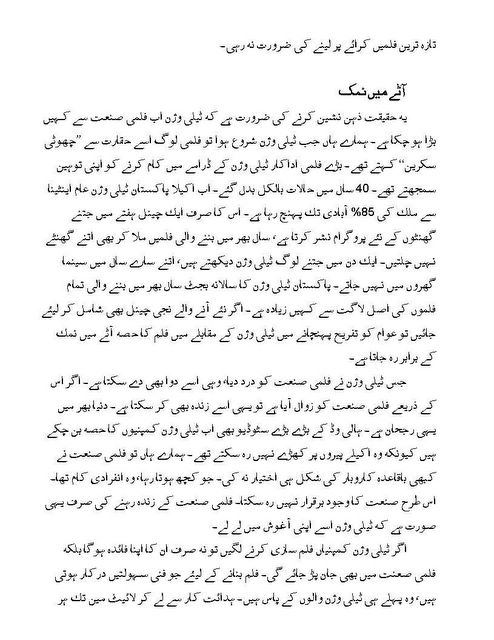
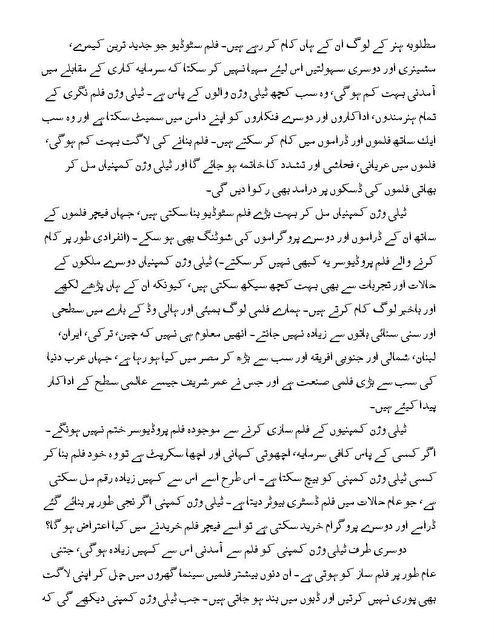

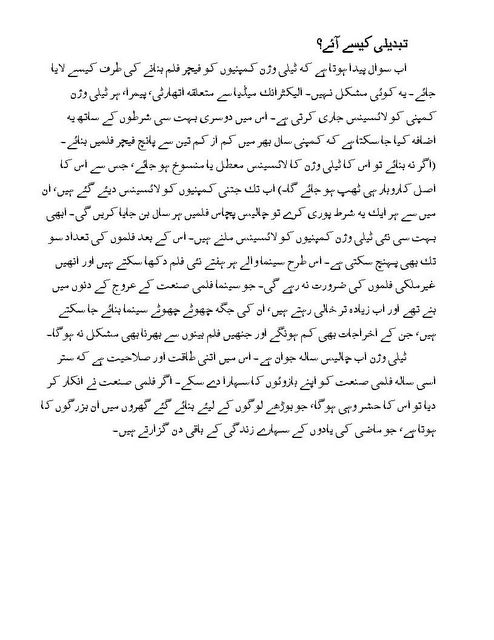
Saturday, February 26, 2005
ENGLISH: It should not be compulsory at B.A. level
Once in a while, we should question the obvious to bring about improvement.
For almost two centuries, we have been teaching English as a compulsory subject to B.A./B.Sc. students. The obvious reason was that it was the wish of the colonial rulers that we should not only learn their language but also absorb their literature and culture and become completely anglicized. No wonder, Urdu was taught only up to 8th class because they did not want any competition for their own language.
After Independence, Urdu moved upwards gradually and became compulsory up to 12th class. Not beyond that. Meanwhile, there has been no change in the status of English.
Of course, English is the key to higher learning in science and technology as well as in other fields. It is also the most widely used language in international relations and trade. However, in all these cases we need English merely as a language and that too at the functional level.
A student at the degree level needs advance study of his own major subjects as he is supposed to have learnt the basics of various subjects when he passed Higher Secondary examination. If he does not have an effective command of English even after 12 years of compulsory study, he cannot do it during the degree class. At the degree level, he should not be burdened with more of a language that he has already been learning and practicing for 12 long years.
Therefore, English should not be taught as a compulsory language at the degree level. Instead, there should be an option to learn the basics of any of the other modern languages, say German, French, Chinese, Japanese, Russian, Korean, etc. for science and technology students and Arabic, Farsi, Turkish, Hindi, etc. for others. The basic knowledge of a modern foreign language will be very helpful when a student goes to the relevant country for higher studies, training or some course later in life. Learning a new modern language will be far more helpful than a little bit more of English.
For almost two centuries, we have been teaching English as a compulsory subject to B.A./B.Sc. students. The obvious reason was that it was the wish of the colonial rulers that we should not only learn their language but also absorb their literature and culture and become completely anglicized. No wonder, Urdu was taught only up to 8th class because they did not want any competition for their own language.
After Independence, Urdu moved upwards gradually and became compulsory up to 12th class. Not beyond that. Meanwhile, there has been no change in the status of English.
Of course, English is the key to higher learning in science and technology as well as in other fields. It is also the most widely used language in international relations and trade. However, in all these cases we need English merely as a language and that too at the functional level.
A student at the degree level needs advance study of his own major subjects as he is supposed to have learnt the basics of various subjects when he passed Higher Secondary examination. If he does not have an effective command of English even after 12 years of compulsory study, he cannot do it during the degree class. At the degree level, he should not be burdened with more of a language that he has already been learning and practicing for 12 long years.
Therefore, English should not be taught as a compulsory language at the degree level. Instead, there should be an option to learn the basics of any of the other modern languages, say German, French, Chinese, Japanese, Russian, Korean, etc. for science and technology students and Arabic, Farsi, Turkish, Hindi, etc. for others. The basic knowledge of a modern foreign language will be very helpful when a student goes to the relevant country for higher studies, training or some course later in life. Learning a new modern language will be far more helpful than a little bit more of English.
Monday, May 31, 2004
LIST OF MY WRITINGS
I write on a wide variety of subjects. My writings mostly reflect analysis, creative thinking and solutions to problems.
The titles in bold italics indicate comprehensive studies while the titles in regular italics indicate papers. Below is a list of my writings:
For more information, please write to me on mahameed40@gmail.com
PLANS
Zameen Allah ki hai (Land belongs to Allah) (Urdu) PDF
The plan can truly bring about a revolution. How, with a change of the ownership of land, every family can get a 1500 sq. ft, 3-bedroom flat for only Rs 1500 per month, every farmer can get 12.5 acres and every industrialist can get free land for factory. Feudalism will fade away.
Towards an ideal society
A plan for the reconstruction of the society through a new national organization
Contents: Objectives; Objectives of the Units; Formation of Units; Organization in the Districts; Relationship with NGOs; Apex Organization; Projection of Performance; Head Office; Action Plan
Rural development through interest-free banking
Contents: The basis of interest-free banking; Need for credit; Basis for loans; Structure of the bank; Capital for the bank; Infrastructure of the bank; Procedure for loans; Marketing and purchases; Business and industry
Transforming the rural society through Panchayats, 1998 (41 pages)
A proposal for the restructure of the panchayat system, including a draft for a new comprehensive Panchayat Act
Contents: Problems of Justice; Pattern of Crime; Formation of Panchayats; Munsifs and Courts; Procedure of Panchayats; Benefits; Next Step; Panchayats in the Punjab in 1952,
Draft of a new Panchayat Act
A plan for celebration of 50 years of Independence, 1997
Suggestions for every section of the society to participate in it
NATIONAL AFFAIRS
An inquiry into a sensational crime in Rawalpindi city
The report on an interesting police investigation into a sensational crime in Rawalpindi city
Papers
Is imprisonment as a punishment against Islam? (Urdu)
The Holy Qur'an does not provide imprisonment as a punishment for any crime, nor were there jails for ordinary criminals in our part of the world before the British colonized it
How to solve some of the basic problems
Suggestions for solving major constitutional, political, judicial and financial problems of the country
A way out on Kashmir
What should be the first step towards solving the Kashmir issue
A plan for universal literacy
How universal literacy can be achieved within a very short period and with practical no expenditure
The repatriation of stranded Pakistanis
The Pakistanis stranded in Bangladesh since 1971 have an irrefutable constitutional and legal case for their repatriation
Declaration for public servants and politicians
Comprehensive form to get information about background, assets and liabilities for public accountability
Leasing of equipment and machinery for Government offices
Government can save huge funds by allowing its offices to lease equipment and machinery
Celebrating the Republic Day on March 23
March 23 was celebrated as Republic Day after the first Constitution was adopted in 1956. After Ayub Khan took over in 1958, it was changed to Pakistan Day. The change should be abolished.
Saving working days by adjusting gazetted holidays
How we can save several working days by combining some non-religious holidays with the nearest weekly holidays
Proposal for a think tank on national affairs
A dictionary of what we really mean by some terms
The meanings of many common terms in plain words
MEDIA
Media – news agencies
A plan for the creation of a new national news agency
How a new national news agency can be set up
A plan for the modernization of Associated Press of Pakistan
How the national news agency should be modernized
A plan for the modernization of Pakistan Press Association
How the biggest private news agency should be modernized
Media - paper
The killing of a newspaper
Personal reminiscences of how 93-year old Civil and Military Gazette, Lahore, was killed
A plan for the publication of a daily newspaper
How to bring out a model daily newspaper, making best use of modern technologies for maximum efficiency and economy
Media – electronic
Analysis of radio broadcasts on BBC World Service
The assignment was given by BBC Radio
Some suggestions for improvement of Radio Pakistan and Pakistan Television
A proposal for a provincial radio-TV network
Media – press laws
Comments on Registration of Printing Presses and Publications Ord. 1990
Analysis of the previous law for the press
Registration of Publications Ordinance – Draft of a new
GOVERNANCE
Constitution
Constitution – Article-by-article critical comments on the, (137 pages)
So many errors, ambiguities, inconsistencies and redundancies have accumulated in the Constitution of Pakistan over the years and so many disparate amendments have been made in most of the Articles that it had better be rewritten or perhaps written anew.
Provinces
Creation of new provinces in the country
Creation of new provinces in the Punjab
Dividing Punjab into more provinces
Creation of new provinces in NWFP
A new capital for the Punjab
A new capital for Balochistan
A new capital for NWFP
A new capital for Sindh
Papers on governance
A plan for creating a National Truth Commission
How all available facts about major events since Independence in 1947 can be gathered and preserved for research and analysis
An outline of a plan for electronic government
How electronic government should be brought about
Prevention of corruption through good governance
How corruption can be attacked at its roots by making some changes in procedures and methods
Acceleration of development
How the process of development can be speeded up.
LOCAL GOVERNMENTS
Local Government system 2003 (Urdu) (171 pages)
Comprehensive coverage of all aspects of the system
Local Government system. Q&A on, (Urdu) (99 pages)
Questions frequently asked by ordinary citizens about the main features of the Local Governments and their answers. Published in a Lahore monthly magazine, “Sputnik,” Nov 2001
Web sites and email system for Local Governments,
including Action Plan for implementation (56 pages)
Contents: Local Government information on web site; Contents of the Districts web site; Sample pages for Zila, Tehsil and Union; Standard format for email addresses; Computers for all Local Government employees; Action plan for web site, email and computers; Email addresses for all Zila, Tehsil and Union Nazims
Coordination between media and the Local Governments (36 pages)
Contents: Why Local Governments need coverage by the media; The problems faced in getting the media coverage; How the media may cover the Local Governments; Office-bearers of the local Press Clubs; Working journalists and editors of publications; Representatives of media – National; Representatives of media – International; Opinion makers in the District; Nazims and Naib Nazims in District and in its Tehsils, DCO, EDOs in the District and TMOs in its Tehsils;
Possible problems
Transparency in Local Governments (109 pages)
ADMINISTRATIVE Public display of information; Free access to information; Right to get a reply; Monitoring Local Government institutions; Verifying background of Local Government staff
ELECTORAL Checking background of election candidates; Taking money out of Local Government elections
FINANCIAL Budget – draft and final; Information on current expenditure; Information on contracts and projects
Implementation plan for Transparency in Local Governments (47 pages)
ADMINISTRATIVE How to display information; Procedure for replying to inquiries; Essentials for making access easy, with order form; Declaration by LG public servants, with form
ELECTORAL Reducing the number of election candidates; Background data on election candidates, with form; State aid for election campaign
FINANCIAL Transparency in preparing budgets; Keeping track of budget revenue and expenditure; Monitoring contracts and projects; Email weekly newsletter on finance
A Monitoring System for Local Governments (219 pages)
Contents: A system for monitoring; The law on monitoring; What is not monitoring; How to monitor; How not to monitor; The need for wider monitoring
An analysis of NARIMS indicators (169 pages)
Applications of NARIMS (National Reconstruction Information Management System) Indicators
Contents: Demographics; Natural features; Services and facilities; Animals and crops; Local Governments; Business and industry; Government organizations; Proposed changes in headings of Broad Indicators
CITY DISTRICTS
City District (36 pages)
How it may come about under the new Local Government system. It will be the ultimate objective of every common district. At present, only four provincial capitals are City Districts out of 100.
City District of Lahore (55 pages)
Contents: Basic considerations; The optimum size of a Town; Delimiting new Towns; Creating new Town centers; Decentralization and adjustments; New capital for the province; What about “Lahore” itself?
City District of Peshawar (29 pages)
Contents: The rural-urban integration; The delimitation of Towns; The creation of new Town centers; The new seat of government
City District of Quetta (30 pages)
Contents: The limits to growth; The challenges of isolation; The delimitation of new Towns; The creation of new Town centers; The new seat of government
CONSUMER PROTECTION
A study on Local Governments and consumer protection (120 pages)
How the Local Governments can help in protecting the interests of the consumers
ROLE OF LOCAL GOVERNMENTS Overview; Union; Village/Neighborhood; Tehsil; District; Citizen Community Boards; Musalihat Anjuman; Monitoring Committees; Zila Muhtasib
CONSUMER PROTECTION Anjuman Sarifeen; Working with the system; Monitoring federal and provincial services; Daily newspaper; Radio stations; Action plan
Papers on Local Governments
On restructuring Union, Tehsil and District
How the three basic units of the Local Governments should be restructured for more efficient governance and economy
The construction of self-financing office complexes in all districts
How office complexes can be constructed in districts on the basis of self-financing.
PUBLIC INFORMATION
An outline of a Public Information System for a transparent and
accountable government (170 pages)
INFORMATION FOR TRANSPARENCY
Government information on Internet; A PC and Internet in every home; A radio station for every district20; Television stations for districts; Watchful eyes in every home; A daily newspaper for every district; Commission on media in the district
INFORMATION FOR ACCOUNTABILITY
Display of information for the public; Free access to official information; Right to get a reply from the government; Right to inspect official institutions; Access to secret government records; Verifying biodata of public servants; Checking the past of representatives; Leveling playing field for candidates; National commission for finding truth
APPENDICES
Text of Freedom of Information Ordinance, 1997; Draft of Freedom of Information Ordinance, 2000; Draft Rules under Freedom of Information Ordinance 2000; Text of National Archives Act, 1993; Proposed amendments in National Archives Act, 1993; Draft Rules under National Archives Act, 1993; Form for information on background of candidates
Papers on public information
Freedom of Information Ordinance 2002, Comments on the draft of
Why the new law on freedom of information does not meet most of the needs of the citizens
Present structures of public information in Pakistan and their proposed restructuring
How the present state-controlled structures of public information should be restructured to meet the needs of present times
Comments on Official Secrets Act
INFORMATION TECHNOLOGY
How the wrong choice of a script hindered personal computing
How the failure to switch over to the character-based form of the Arabic script (Naskh) left Urdu far behind in the use of computers
Comments on draft IT policy of Pakistan Government, 2000 (14 pages)
Suggestions on various aspects of the proposed IT policy
Internet
The Internet in Pakistan
Interview with an Indian publication i4donline March 2004 issue
How the internet will impact the media
Future of Internet and the role of PTA, PTC and Government
Telecommunications
Privatization of Pakistan Telecommunication Co.
How PTC can make best use of its idle telecommunications circuits
ECONOMY
Land utilization in a Punjab village, 1961
The thesis was submitted for M.A. Economics degree
GENERAL Location; Origin and History; Population; Health; Education; Transport and Communications; Marketing; Credit; Tenancy
LAND Physical Features; Soil; Rainfall and Climate; Sources of Irrigation; Classification of Area; Trees; Intensity of Cultivation; Classification of area according to Source of Irrigation; Fallowness
CROPS Cropping Pattern; Major Crops; Variation in the Acreage of Major Crops; Variation in the Acreage of other Crops; Rotation of Crops; Crop Failures; Average Yield
TECHNIQUES Ploughing; Manure; Seed; Watering; Weeding; Implements
CONCLUSIONS AND RECENT TRENDS General; Land; Crops; Techniques
INTERNATIONAL AFFAIRS
Police mutiny in Uttar Pradesh of India, 1973
How the police in the Uttar Pradesh state of India mutinied in 1973, how it was suppressed and what were the causes behind it
THE MUTINY The Gathering Storm; Students and PAC join hands; Clash in the Biggest City; "Mutiny" in C. M.'s Home Town; Oath to Fight until Death;
THE AFTERMATH At the End of the Day; Reorganization and Changes;
THE CAUSES Indecisive Government; Collusion of the Intelligence; Were Politicians Involved? Appalling Service Conditions; Premium on Violence; Moral of the Story
APPENDICES What Ails U.P. Police; Mounting Police Grievances; Case for Abolition of Armed Police Forces; Officers or Glorified Orderlies? Welfare of the Policemen in Andhra Pradesh
Papers
Afghanistan
What the Taliban did wrong
Where did Usama bin Laden go after U.S. invasion of Afghanistan?
An analysis of Usama’s famous videotape that emerged after the invasion
Iran
The game plan against Iran
Palestine
A way out in Palestine
Sikhs
Yatra Special for Sikhs in India
Export processing zone for Sikh investors in Nankana Sahib
Sri Lanka
How to restore peace in Sri Lanka
U.S.
The alternative plan for re-election of President Bush
SPECIAL PRESENTATION
"Tricks, Not Truth: What I saw and heard in the chambers and corridors of power"
By Sardar Muhammad, former chief of Police and Intelligence of the Punjab
Edited by Muhammad Abd al-Hameed
The titles in bold italics indicate comprehensive studies while the titles in regular italics indicate papers. Below is a list of my writings:
For more information, please write to me on mahameed40@gmail.com
PLANS
Zameen Allah ki hai (Land belongs to Allah) (Urdu) PDF
The plan can truly bring about a revolution. How, with a change of the ownership of land, every family can get a 1500 sq. ft, 3-bedroom flat for only Rs 1500 per month, every farmer can get 12.5 acres and every industrialist can get free land for factory. Feudalism will fade away.
Towards an ideal society
A plan for the reconstruction of the society through a new national organization
Contents: Objectives; Objectives of the Units; Formation of Units; Organization in the Districts; Relationship with NGOs; Apex Organization; Projection of Performance; Head Office; Action Plan
Rural development through interest-free banking
Contents: The basis of interest-free banking; Need for credit; Basis for loans; Structure of the bank; Capital for the bank; Infrastructure of the bank; Procedure for loans; Marketing and purchases; Business and industry
Transforming the rural society through Panchayats, 1998 (41 pages)
A proposal for the restructure of the panchayat system, including a draft for a new comprehensive Panchayat Act
Contents: Problems of Justice; Pattern of Crime; Formation of Panchayats; Munsifs and Courts; Procedure of Panchayats; Benefits; Next Step; Panchayats in the Punjab in 1952,
Draft of a new Panchayat Act
A plan for celebration of 50 years of Independence, 1997
Suggestions for every section of the society to participate in it
NATIONAL AFFAIRS
An inquiry into a sensational crime in Rawalpindi city
The report on an interesting police investigation into a sensational crime in Rawalpindi city
Papers
Is imprisonment as a punishment against Islam? (Urdu)
The Holy Qur'an does not provide imprisonment as a punishment for any crime, nor were there jails for ordinary criminals in our part of the world before the British colonized it
How to solve some of the basic problems
Suggestions for solving major constitutional, political, judicial and financial problems of the country
A way out on Kashmir
What should be the first step towards solving the Kashmir issue
A plan for universal literacy
How universal literacy can be achieved within a very short period and with practical no expenditure
The repatriation of stranded Pakistanis
The Pakistanis stranded in Bangladesh since 1971 have an irrefutable constitutional and legal case for their repatriation
Declaration for public servants and politicians
Comprehensive form to get information about background, assets and liabilities for public accountability
Leasing of equipment and machinery for Government offices
Government can save huge funds by allowing its offices to lease equipment and machinery
Celebrating the Republic Day on March 23
March 23 was celebrated as Republic Day after the first Constitution was adopted in 1956. After Ayub Khan took over in 1958, it was changed to Pakistan Day. The change should be abolished.
Saving working days by adjusting gazetted holidays
How we can save several working days by combining some non-religious holidays with the nearest weekly holidays
Proposal for a think tank on national affairs
A dictionary of what we really mean by some terms
The meanings of many common terms in plain words
MEDIA
Media – news agencies
A plan for the creation of a new national news agency
How a new national news agency can be set up
A plan for the modernization of Associated Press of Pakistan
How the national news agency should be modernized
A plan for the modernization of Pakistan Press Association
How the biggest private news agency should be modernized
Media - paper
The killing of a newspaper
Personal reminiscences of how 93-year old Civil and Military Gazette, Lahore, was killed
A plan for the publication of a daily newspaper
How to bring out a model daily newspaper, making best use of modern technologies for maximum efficiency and economy
Media – electronic
Analysis of radio broadcasts on BBC World Service
The assignment was given by BBC Radio
Some suggestions for improvement of Radio Pakistan and Pakistan Television
A proposal for a provincial radio-TV network
Media – press laws
Comments on Registration of Printing Presses and Publications Ord. 1990
Analysis of the previous law for the press
Registration of Publications Ordinance – Draft of a new
GOVERNANCE
Constitution
Constitution – Article-by-article critical comments on the, (137 pages)
So many errors, ambiguities, inconsistencies and redundancies have accumulated in the Constitution of Pakistan over the years and so many disparate amendments have been made in most of the Articles that it had better be rewritten or perhaps written anew.
Provinces
Creation of new provinces in the country
Creation of new provinces in the Punjab
Dividing Punjab into more provinces
Creation of new provinces in NWFP
A new capital for the Punjab
A new capital for Balochistan
A new capital for NWFP
A new capital for Sindh
Papers on governance
A plan for creating a National Truth Commission
How all available facts about major events since Independence in 1947 can be gathered and preserved for research and analysis
An outline of a plan for electronic government
How electronic government should be brought about
Prevention of corruption through good governance
How corruption can be attacked at its roots by making some changes in procedures and methods
Acceleration of development
How the process of development can be speeded up.
LOCAL GOVERNMENTS
Local Government system 2003 (Urdu) (171 pages)
Comprehensive coverage of all aspects of the system
Local Government system. Q&A on, (Urdu) (99 pages)
Questions frequently asked by ordinary citizens about the main features of the Local Governments and their answers. Published in a Lahore monthly magazine, “Sputnik,” Nov 2001
Web sites and email system for Local Governments,
including Action Plan for implementation (56 pages)
Contents: Local Government information on web site; Contents of the Districts web site; Sample pages for Zila, Tehsil and Union; Standard format for email addresses; Computers for all Local Government employees; Action plan for web site, email and computers; Email addresses for all Zila, Tehsil and Union Nazims
Coordination between media and the Local Governments (36 pages)
Contents: Why Local Governments need coverage by the media; The problems faced in getting the media coverage; How the media may cover the Local Governments; Office-bearers of the local Press Clubs; Working journalists and editors of publications; Representatives of media – National; Representatives of media – International; Opinion makers in the District; Nazims and Naib Nazims in District and in its Tehsils, DCO, EDOs in the District and TMOs in its Tehsils;
Possible problems
Transparency in Local Governments (109 pages)
ADMINISTRATIVE Public display of information; Free access to information; Right to get a reply; Monitoring Local Government institutions; Verifying background of Local Government staff
ELECTORAL Checking background of election candidates; Taking money out of Local Government elections
FINANCIAL Budget – draft and final; Information on current expenditure; Information on contracts and projects
Implementation plan for Transparency in Local Governments (47 pages)
ADMINISTRATIVE How to display information; Procedure for replying to inquiries; Essentials for making access easy, with order form; Declaration by LG public servants, with form
ELECTORAL Reducing the number of election candidates; Background data on election candidates, with form; State aid for election campaign
FINANCIAL Transparency in preparing budgets; Keeping track of budget revenue and expenditure; Monitoring contracts and projects; Email weekly newsletter on finance
A Monitoring System for Local Governments (219 pages)
Contents: A system for monitoring; The law on monitoring; What is not monitoring; How to monitor; How not to monitor; The need for wider monitoring
An analysis of NARIMS indicators (169 pages)
Applications of NARIMS (National Reconstruction Information Management System) Indicators
Contents: Demographics; Natural features; Services and facilities; Animals and crops; Local Governments; Business and industry; Government organizations; Proposed changes in headings of Broad Indicators
CITY DISTRICTS
City District (36 pages)
How it may come about under the new Local Government system. It will be the ultimate objective of every common district. At present, only four provincial capitals are City Districts out of 100.
City District of Lahore (55 pages)
Contents: Basic considerations; The optimum size of a Town; Delimiting new Towns; Creating new Town centers; Decentralization and adjustments; New capital for the province; What about “Lahore” itself?
City District of Peshawar (29 pages)
Contents: The rural-urban integration; The delimitation of Towns; The creation of new Town centers; The new seat of government
City District of Quetta (30 pages)
Contents: The limits to growth; The challenges of isolation; The delimitation of new Towns; The creation of new Town centers; The new seat of government
CONSUMER PROTECTION
A study on Local Governments and consumer protection (120 pages)
How the Local Governments can help in protecting the interests of the consumers
ROLE OF LOCAL GOVERNMENTS Overview; Union; Village/Neighborhood; Tehsil; District; Citizen Community Boards; Musalihat Anjuman; Monitoring Committees; Zila Muhtasib
CONSUMER PROTECTION Anjuman Sarifeen; Working with the system; Monitoring federal and provincial services; Daily newspaper; Radio stations; Action plan
Papers on Local Governments
On restructuring Union, Tehsil and District
How the three basic units of the Local Governments should be restructured for more efficient governance and economy
The construction of self-financing office complexes in all districts
How office complexes can be constructed in districts on the basis of self-financing.
PUBLIC INFORMATION
An outline of a Public Information System for a transparent and
accountable government (170 pages)
INFORMATION FOR TRANSPARENCY
Government information on Internet; A PC and Internet in every home; A radio station for every district20; Television stations for districts; Watchful eyes in every home; A daily newspaper for every district; Commission on media in the district
INFORMATION FOR ACCOUNTABILITY
Display of information for the public; Free access to official information; Right to get a reply from the government; Right to inspect official institutions; Access to secret government records; Verifying biodata of public servants; Checking the past of representatives; Leveling playing field for candidates; National commission for finding truth
APPENDICES
Text of Freedom of Information Ordinance, 1997; Draft of Freedom of Information Ordinance, 2000; Draft Rules under Freedom of Information Ordinance 2000; Text of National Archives Act, 1993; Proposed amendments in National Archives Act, 1993; Draft Rules under National Archives Act, 1993; Form for information on background of candidates
Papers on public information
Freedom of Information Ordinance 2002, Comments on the draft of
Why the new law on freedom of information does not meet most of the needs of the citizens
Present structures of public information in Pakistan and their proposed restructuring
How the present state-controlled structures of public information should be restructured to meet the needs of present times
Comments on Official Secrets Act
INFORMATION TECHNOLOGY
How the wrong choice of a script hindered personal computing
How the failure to switch over to the character-based form of the Arabic script (Naskh) left Urdu far behind in the use of computers
Comments on draft IT policy of Pakistan Government, 2000 (14 pages)
Suggestions on various aspects of the proposed IT policy
Internet
The Internet in Pakistan
Interview with an Indian publication i4donline March 2004 issue
How the internet will impact the media
Future of Internet and the role of PTA, PTC and Government
Telecommunications
Privatization of Pakistan Telecommunication Co.
How PTC can make best use of its idle telecommunications circuits
ECONOMY
Land utilization in a Punjab village, 1961
The thesis was submitted for M.A. Economics degree
GENERAL Location; Origin and History; Population; Health; Education; Transport and Communications; Marketing; Credit; Tenancy
LAND Physical Features; Soil; Rainfall and Climate; Sources of Irrigation; Classification of Area; Trees; Intensity of Cultivation; Classification of area according to Source of Irrigation; Fallowness
CROPS Cropping Pattern; Major Crops; Variation in the Acreage of Major Crops; Variation in the Acreage of other Crops; Rotation of Crops; Crop Failures; Average Yield
TECHNIQUES Ploughing; Manure; Seed; Watering; Weeding; Implements
CONCLUSIONS AND RECENT TRENDS General; Land; Crops; Techniques
INTERNATIONAL AFFAIRS
Police mutiny in Uttar Pradesh of India, 1973
How the police in the Uttar Pradesh state of India mutinied in 1973, how it was suppressed and what were the causes behind it
THE MUTINY The Gathering Storm; Students and PAC join hands; Clash in the Biggest City; "Mutiny" in C. M.'s Home Town; Oath to Fight until Death;
THE AFTERMATH At the End of the Day; Reorganization and Changes;
THE CAUSES Indecisive Government; Collusion of the Intelligence; Were Politicians Involved? Appalling Service Conditions; Premium on Violence; Moral of the Story
APPENDICES What Ails U.P. Police; Mounting Police Grievances; Case for Abolition of Armed Police Forces; Officers or Glorified Orderlies? Welfare of the Policemen in Andhra Pradesh
Papers
Afghanistan
What the Taliban did wrong
Where did Usama bin Laden go after U.S. invasion of Afghanistan?
An analysis of Usama’s famous videotape that emerged after the invasion
Iran
The game plan against Iran
Palestine
A way out in Palestine
Sikhs
Yatra Special for Sikhs in India
Export processing zone for Sikh investors in Nankana Sahib
Sri Lanka
How to restore peace in Sri Lanka
U.S.
The alternative plan for re-election of President Bush
SPECIAL PRESENTATION
"Tricks, Not Truth: What I saw and heard in the chambers and corridors of power"
By Sardar Muhammad, former chief of Police and Intelligence of the Punjab
Edited by Muhammad Abd al-Hameed
Subscribe to:
Posts (Atom)